
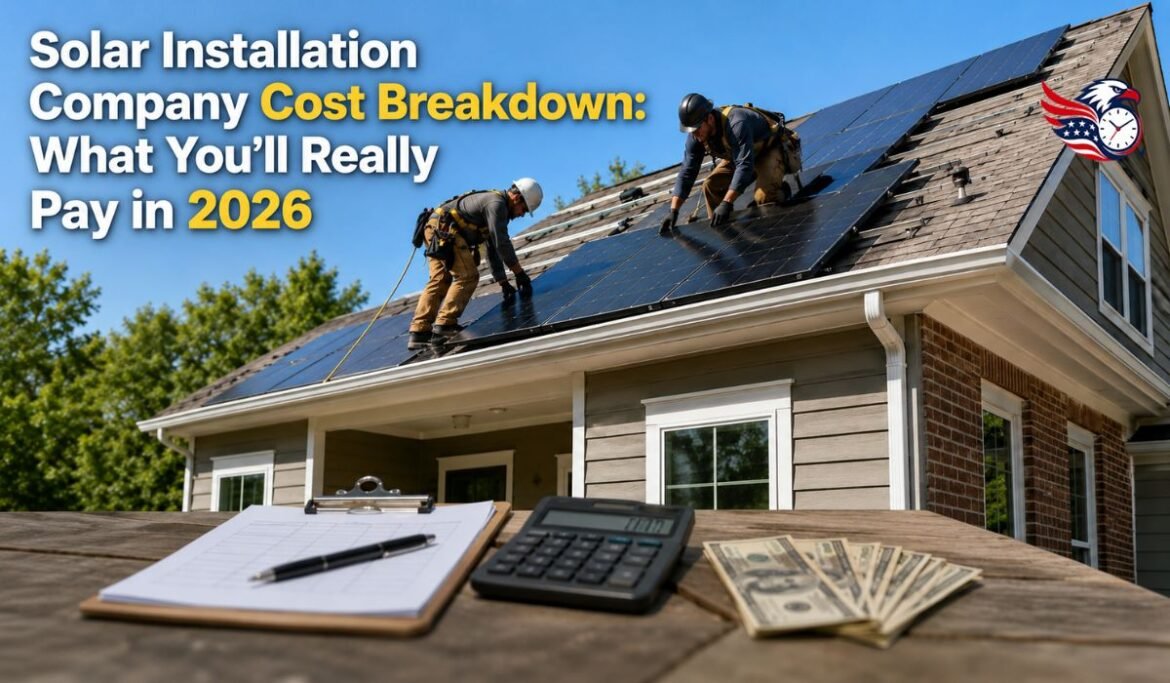
Thinking about going solar in 2026? One of the first questions most homeowners ask is simple: how much will it actually cost. The answer depends on several moving parts, and prices have shifted this year because of changes to federal incentives. This guide breaks down exactly what a solar installation company charges, why prices vary so much from one home to the next, and how you can avoid overpaying. By the end, you will understand the full picture, not just a rough number pulled from an ad.
What Determines the Price a Solar Installation Company Charges
No two solar quotes look the same, even for homes on the same street. A solar installation company bases its price on your energy usage, the size of the system needed to cover it, your roof condition, and the equipment you choose. Labor costs also play a bigger role than most people expect. In fact, the panels themselves usually make up only a small slice of your total bill. Most of the money goes toward design, permitting, wiring, inspections, and the crew that installs everything safely on your roof.
System Size and Energy Needs
Your monthly electric bill is the starting point for almost every quote. A home that uses more electricity needs a bigger system, and a bigger system costs more upfront, even though it often costs less per watt. This is because larger installations spread fixed costs, like permits and truck rolls, across more equipment. A small 5 kW system may cost more per watt than a large 12 kW system, even though the smaller one has a lower total price.
Roof Type and Home Location
Your roof shape and material change the price too. Steep roofs, multiple angles, or older shingles that need reinforcement all add labor time. Metal, tile, and flat roofs typically cost a bit more to work with than standard asphalt shingles. Where you live matters as well. States with higher labor costs, stricter permitting rules, or fewer local installers tend to have higher prices, while competitive markets with many installers often see lower rates due to pricing pressure.
Average Cost of Hiring a Solar Installation Company in 2026
Nationally, homeowners are paying between roughly two dollars and fifty cents and three dollars per watt of installed solar capacity in 2026, before any incentives are applied. For a typical home needing a 7 to 8 kilowatt system, that translates to a total cost somewhere between eighteen thousand and twenty-six thousand dollars. Smaller homes with lower energy use might spend closer to fifteen thousand dollars, while larger homes with pools, electric vehicles, or home offices could see quotes above thirty thousand dollars. These numbers are before incentives, so your final out-of-pocket cost may look different once local programs are factored in.
Why Federal Tax Credit Changes Affect Your 2026 Price
This is one of the biggest shifts homeowners need to understand this year. The federal tax credit that used to let homeowners deduct thirty percent of their solar costs expired at the end of 2025. That means anyone buying a system with cash or a loan in 2026 will not receive that federal discount anymore. This has pushed effective prices higher compared to previous years, even though the raw cost of equipment and labor has stayed fairly stable. The only remaining federal benefit applies to leased systems or power purchase agreements, where a third-party company still owns the panels and can claim a separate credit, sometimes passing part of the savings on to you through a lower monthly rate.
Cost Per Watt Explained in Simple Terms
You will hear the term “cost per watt” often when comparing quotes, and it is worth understanding because it lets you compare systems of different sizes fairly. If a company quotes you eighteen thousand dollars for a 7,000-watt system, you divide the price by the wattage to get about two dollars and fifty-seven cents per watt. A lower number generally means a better deal, but it is not the only thing that matters. Equipment quality, warranty length, and installer reputation all affect whether a low price per watt is actually a good value or a sign of corners being cut.
Residential vs Commercial Pricing
Homeowners and business owners face very different price ranges. A residential solar installation company typically quotes homes between fifteen thousand and thirty-five thousand dollars depending on size. Commercial projects work on a much larger scale, often starting around one hundred thousand dollars and climbing well past half a million dollars for large facilities. Interestingly, commercial systems usually cost less per watt than residential ones because of the sheer size of the installation and the efficiency of installing many panels at once. Business owners also have access to different depreciation benefits that residential customers do not, which can change the real cost significantly over time.
Hidden Costs Homeowners Often Forget
Many homeowners focus only on the headline price and forget about smaller costs that add up. A reliable solar installation company should walk you through these before you sign anything, but it helps to ask directly if they are not mentioned upfront.
- Roof repairs or reinforcement needed before panels can be safely installed
- Electrical panel upgrades if your current panel cannot handle the new system
- Permitting and inspection fees charged by your city or county
- Battery storage, which is optional but can add eight thousand dollars or more
- Ongoing maintenance, such as occasional cleaning or inverter replacement after ten to fifteen years
Financing Options That Change Your Monthly Payment
Very few homeowners pay the full price in cash. Most use a solar loan, which spreads the cost over ten to twenty-five years but adds interest, sometimes bringing the effective cost per watt noticeably higher than a cash purchase. Leases and power purchase agreements offer a different path, letting you pay a fixed monthly rate for the electricity the system produces without owning the equipment yourself. This usually means little to no upfront cost, but you give up ownership benefits and long-term savings compared to buying outright. Choosing between these options depends on how long you plan to stay in your home and how much upfront cash you are comfortable spending.
How to Compare Quotes From Different Companies
Getting only one quote is one of the most common mistakes homeowners make. Prices can vary by thousands of dollars between companies for a nearly identical system, so gathering three to five quotes gives you a realistic sense of fair pricing in your area. When comparing, look past the bottom-line number and check the equipment brand, the warranty length, the estimated energy production, and whether the price includes permitting and inspection fees. A cheaper quote that skips key protections can end up costing more in the long run if something breaks and is not covered.
Long-Term Savings and Payback Period
While the upfront number can feel large, most homeowners recover their investment over time through lower electricity bills. The typical payback period lands somewhere between seven and twelve years, depending on your state’s electricity rates and how much sunlight your home receives. After that point, the electricity your system produces is essentially free for the remaining fifteen to twenty years of the panels’ working life. Over a twenty-five-year span, many households save well into the tens of thousands of dollars compared to staying on the grid, especially as utility rates continue climbing year after year.
Red Flags That Signal an Overpriced Quote
Some pricing tactics are worth watching for. If a company pressures you to sign the same day for a “special discount,” treats every home the same regardless of roof type or energy use, or refuses to explain their per-watt pricing clearly, take that as a warning sign. A trustworthy solar installation company will happily break down labor, equipment, and permitting costs separately and will not rush your decision. Comparing your quote’s cost per watt against the national average is a quick way to spot a number that seems unusually high for your area.
Final Thoughts
Solar pricing in 2026 looks different than it did just a year ago, mainly because of the expired federal tax credit. That said, solar remains a solid long-term investment for most homeowners, especially in states with strong sunlight and rising utility rates. The real key to getting a fair deal is understanding what goes into your price, comparing several quotes, and asking questions about anything that feels vague. A transparent solar installation company will walk you through every line item without hesitation, and that transparency is often the clearest sign you are working with a team worth trusting with your roof and your budget.
Frequently Asked Questions (FAQs)
1. How much does a solar installation company usually charge in 2026?
Most homeowners pay between two dollars and fifty cents and three dollars per watt, which works out to roughly eighteen thousand to twenty-six thousand dollars for a typical home system before any local incentives are applied.
2. Is solar still worth it without the federal tax credit?
Yes, for most homeowners it still makes sense over time, since electricity bill savings and rising utility rates usually make up for the loss of the federal discount within a reasonable payback period.
3. How long does it take to pay off a solar system?
Most homeowners break even somewhere between seven and twelve years, depending on their local electricity rates, sunlight levels, and how the system was financed.
4. Should I pay cash or finance my solar installation?
Cash purchases avoid interest and maximize long-term savings, while loans or leases lower the upfront cost but reduce your total savings over the life of the system.
5. Why do solar quotes vary so much between companies?
Pricing differs based on equipment brand, labor rates, roof complexity, warranty coverage, and how much profit margin each company builds into its offer, so getting multiple quotes is the best way to spot a fair price.
6. Do I need a battery with my solar system?
A battery is optional and mainly useful if you want backup power during outages or plan to use stored energy during evening hours, but it typically adds several thousand dollars to your total cost.
7. How can I tell if a solar quote is overpriced?
Compare the cost per watt against your state’s average, ask for a clear breakdown of labor and equipment costs, and be cautious of any company that pressures you to sign without time to compare other offers.
Read Next: Top Travel Tips for Beginners: Money, SIM Cards & Airport Hacks Explained






One thought on “Solar Installation Company Cost Breakdown: What You’ll Really Pay in 2026”
Comments are closed.