
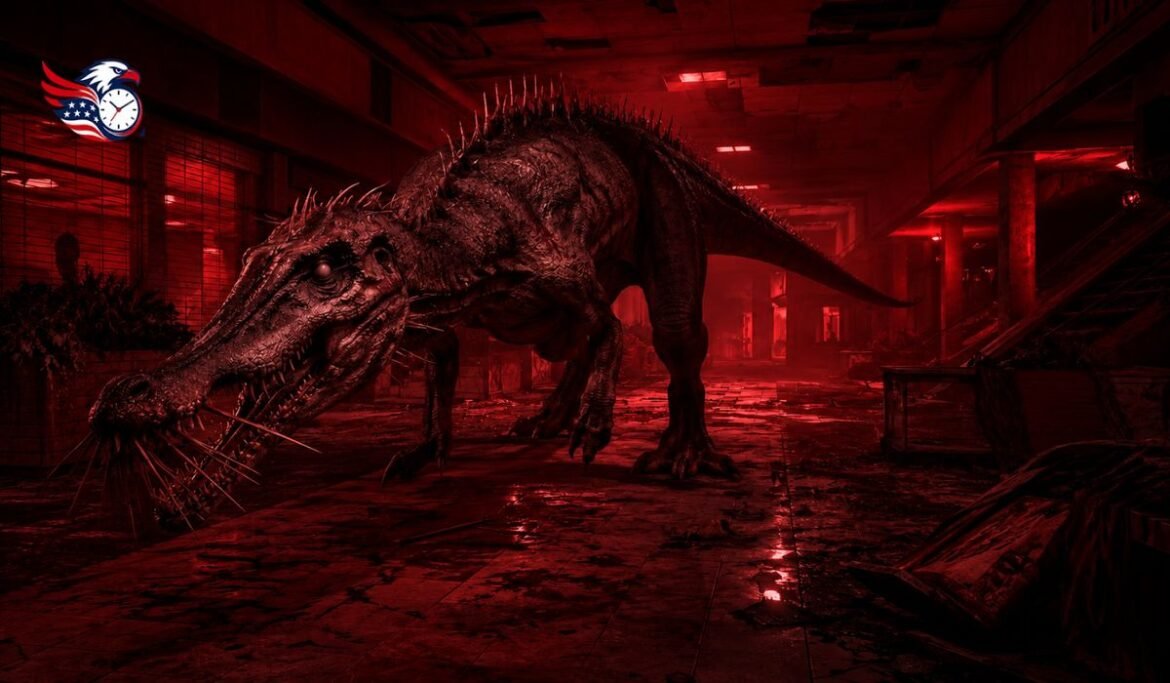
Hastovenator is the terrifying dinosaur-like creature at the center of Blood Mall, a short indie horror game created by Ollie Hall. The game places players inside Dayton County Mall after an unexplained massacre leaves hundreds of people dead or injured. What first appears to be an ordinary emergency soon turns into a hunt for a fast, intelligent, and deeply unnatural predator. The creature does not simply chase its victims. It stalks them, reacts to bait, attacks from a distance, and turns familiar shopping spaces into dangerous hunting grounds. Its unusual body, pale eyes, powerful jaws, and spear-like projectiles have helped it stand apart from more traditional video game dinosaurs. However, the mystery surrounding its arrival is just as important as its appearance. The game gives players enough clues to understand the immediate danger without fully explaining where the animal came from. That uncertainty has encouraged theories about prehistoric survival, scientific experimentation, and supernatural forces. This guide explores what the monster is, what its name means, how it behaves, and why it became such a memorable horror boss.
What Is Hastovenator?
Hastovenator is a fictional prehistoric predator created specifically for the Blood Mall universe. It is not a recognized dinosaur genus, and no confirmed fossil species carries this name. The creature is presented as a Triassic proto-dinosaur, although its anatomy combines features from several real and imagined animals. It moves like a large theropod, attacks with sharp claws and teeth, and possesses a heavily built body suited to overpowering human prey. Its most unusual feature is its ability to produce and fire hard, spear-like quills from its mouth. This natural ranged weapon prevents victims from remaining safe simply by keeping their distance. In the original game, the animal serves as the main threat behind the Dayton County Mall disaster. Players enter the building after the attack and must survive long enough to confront it. Although it can be described as a boss, it also functions as a persistent slasher-style villain. Its presence shapes the entire experience, even during moments when it cannot be seen. Every dark doorway, overturned display, and blood-covered corridor suggests that the hunter may be nearby.
What Does the Name Hastovenator Mean?
The creature’s name explains its defining ability. According to creator Ollie Hall, Hastovenator means “Spear Hunter,” combining language associated with a spear or lance and a hunter. The name follows the dramatic style used for many prehistoric animals while directly referring to the monster’s projectile attack. Rather than relying only on teeth and claws, the predator launches sharp quills from its mouth with deadly force. This makes “Spear Hunter” both a scientific-sounding label and a warning about how it kills. The name also gives the fictional animal a sense of history. It sounds as though a paleontologist could have assigned it after studying fossil remains, yet its unnatural biology prevents it from feeling like an ordinary museum dinosaur. This balance between plausibility and fantasy is central to the design. Players can recognize the basic shape of a prehistoric hunter, but they cannot predict all its abilities. The unfamiliar name strengthens that uncertainty because it suggests a species with its own evolutionary path, behavior, and place within the game’s expanding mythology.
Hastovenator’s Origin Story in Blood Mall
The exact origin of the monster remains deliberately unclear. Blood Mall begins with the results of the disaster rather than a complete explanation of what caused it. The story is dated November 3, 1988, when Dayton County Mall becomes the scene of a massive attack. Public information describes the event as a gas leak, but the horrifying conditions inside the building reveal that this account is false or incomplete. Hundreds are reported dead, while more than 350 people are injured. The player is sent into the mall to stop the creature and end the massacre. This setup creates several immediate questions. How did a supposed Triassic animal appear in a modern shopping center? Who knew about it before the attack? Why would officials hide the truth behind a safer explanation? The original release does not settle every question, so the monster’s origin should not be presented as a confirmed laboratory story, time-travel event, or demonic resurrection. Those remain possible interpretations rather than established facts. The mystery is part of the horror because players must face something that appears scientifically impossible without receiving a comforting explanation.
Is Hastovenator a Real Dinosaur?
Hastovenator is not a real dinosaur known to science. It belongs to speculative fiction and was designed to support the tense, exaggerated world of Blood Mall. Calling it a Triassic proto-dinosaur provides a loose prehistoric identity, but its physical features are not a strict reconstruction of one verified species. Its design appears to borrow recognizable qualities from large theropods, raptor-like hunters, crocodilians, and other dangerous animals. The heavy body gives it physical authority, while its long snout and visible teeth create an aquatic-reptile or crocodile-like impression. Its claws suggest an animal capable of grabbing, cutting, and controlling prey at close range. The white or pale eyes make it appear less natural and more ghostly, especially under the mall’s weak lighting. Most importantly, no known dinosaur could create an endless supply of large quills and fire them from its mouth as weapons. That ability belongs completely to horror fantasy. The mixture works because the creature looks believable at first glance. Only after it attacks does the player discover how far its biology has moved beyond real paleontology.
How Does the Spear Hunter Attack?
The Spear Hunter is dangerous because it can threaten players from more than one position. Many dinosaur games allow a player to escape by creating distance, climbing onto an object, or shooting from across a room. This predator weakens that sense of safety through its mouth-fired quills. The projectiles allow it to punish a target who remains exposed, while its speed and physical strength keep close encounters equally dangerous. The original game also uses bait-and-hide sequences that require the player to draw the animal into a suitable position. These moments make preparation important, but they never turn the creature into a simple target. The developer later acknowledged that the original bait sections were created quickly for a game-jam deadline and could feel scripted or punishing. Even so, they reveal an essential part of the concept: this is a hunting contest. The player must study the environment, control the monster’s attention, and act at the correct time. Poor timing can turn the hunter into the hunted within seconds, which gives each encounter a strong survival-horror rhythm.
Why Is the Blood Mall Monster So Frightening?
The creature becomes frightening through the combination of its design, behavior, and surroundings. A dinosaur in an open jungle would still be dangerous, but a dinosaur inside a shopping mall feels deeply wrong. Stores, food courts, service corridors, and display areas were built for ordinary daily life. They offer narrow routes, blocked sightlines, reflective surfaces, and hiding places that may protect either the player or the predator. The late-1980s setting adds another layer of isolation. Modern phones, digital maps, and easy communication are absent, leaving the incident trapped in a world of emergency broadcasts, limited information, and official cover stories. Several qualities define the threat clearly:
- It has a powerful prehistoric body; it can attack at close or long range; its pale eyes make it appear unnatural; it understands movement and bait; its true origin is unknown; and the enclosed mall gives victims few reliable escape routes.
Together, these details make the animal feel more like a calculating horror villain than a simple wild beast. Players are not only fighting its strength. They are fighting uncertainty about where it is and what it may do next.
The Importance of the 1988 Mall Setting
Setting the disaster in 1988 gives Blood Mall its visual identity and helps explain why the incident feels like a buried local legend. The game uses a retro presentation influenced by VHS recordings and older survival-horror experiences. Grainy images, harsh lighting, blood-covered interiors, and limited visual clarity make it harder to separate real danger from background shapes. A shopping mall is also an effective stage because it represents comfort, entertainment, and consumer life. Families visit malls to eat, shop, socialize, and spend time indoors. Turning that space into a hunting territory creates an immediate contrast between safety and violence. The creature appears to invade not only a building but an entire version of normal American life. The official “gas leak” explanation strengthens the period atmosphere. Before social media and camera phones, authorities could control information more easily, especially during a confusing local emergency. Whether the cover story exists to prevent panic or conceal deeper knowledge is left uncertain. That silence allows the Dayton County Mall massacre to feel larger than the events shown directly on screen.
Theories About Where the Creature Came From
Because the first game protects much of the mystery, players have offered different explanations for the animal’s appearance. One theory suggests it survived from prehistoric times in an isolated place before being captured or released. Another imagines that scientists reconstructed or altered ancient genetic material, producing a creature whose quill weapon was deliberately engineered. A supernatural theory treats the animal as a demonic being wearing the shape of a dinosaur. Its pale eyes, impossible attack, and sudden arrival support that interpretation. Others believe the government or another organization knew about it and used the gas-leak report to hide a failed experiment. None of these ideas should be treated as proven unless later entries provide direct confirmation. The available story establishes the massacre, the cover-up, and the existence of an impossible predator, but it does not offer a complete scientific history. That open space is useful storytelling. A detailed laboratory report might make the monster easier to understand, while uncertainty keeps it disturbing. Players know what it does, yet they cannot fully explain what kind of being they are confronting.
Hastovenator in Blood Mall: Retaped and Part II
The creature’s story extends beyond the earliest free release. Blood Mall: Retaped revisits the original concept with improved visuals, additional content, heavier gore, and a more detailed version of the central predator. The updated design makes the animal’s skin, anatomy, claws, head, and body feel more physically present. Better detail can sometimes make a monster less frightening by revealing too much, but here it emphasizes the weight and violence of the creature. The series is also continuing through Blood Mall: Part II, which follows the events of the first game and expands the incident into what is called the Hastovenator Crisis. The sequel’s larger structure, new locations, weapons, characters, and additional enemies suggests that the mall attack was only the beginning. This wider conflict may eventually answer some questions about the original animal, its possible reproduction, and the forces connected to it. Until those details are clearly established within the games, it remains safest to separate confirmed story information from fan interpretation. What is certain is that the predator has grown from a single game-jam monster into the central symbol of a developing indie horror series.
Why Hastovenator Stands Out in Indie Horror
Many horror games use ghosts, masked killers, zombies, or ordinary dinosaurs. Hastovenator succeeds because it combines familiar ideas without feeling like a direct copy of one famous creature. Its dinosaur shape creates instant danger, the quill attack changes how players approach combat, and the mall gives it an unusual hunting ground. The short format also works in its favor. The game introduces the disaster, builds tension, and moves toward confrontation before the central idea becomes tired. Its rough retro style supports the B-movie tone while leaving room for genuine fear. The monster can be disturbing and slightly outrageous at the same time, which gives the experience personality. It also encourages discussion because its fictional biology invites questions. Viewers can debate whether it resembles a raptor, crocodilian, proto-dinosaur, supernatural entity, or engineered weapon. That uncertainty keeps the design memorable after the game ends. Instead of being only a final obstacle, it becomes the mystery that connects the setting, the cover-up, the massacre, and the future of the series.
Final Thoughts
Hastovenator is a fictional Triassic-inspired predator and the signature monster of Ollie Hall’s Blood Mall. Its name means “Spear Hunter,” an appropriate description of the sharp quills it fires from its mouth. Yet its appeal goes beyond that unusual weapon. The creature works because it enters a familiar place, destroys its sense of safety, and leaves behind questions that the original story refuses to answer fully. The 1988 Dayton County Mall massacre, the doubtful gas-leak explanation, and the predator’s impossible biology suggest a larger secret without reducing it to one simple origin. Updated and expanded releases have made the animal more detailed and the crisis more ambitious, but its central mystery remains valuable. It is not a real dinosaur, nor should speculation about experiments or supernatural forces be mistaken for confirmed history. It is a carefully designed horror antagonist that feels ancient, intelligent, and out of place. By blending prehistoric fear with retro mall horror, the Spear Hunter has earned a distinctive position among modern indie monsters.
Frequently Asked Questions (FAQs)
1. Is Hastovenator a real dinosaur?
No. It is a fictional prehistoric creature designed for the Blood Mall games. No officially recognized fossil genus has this name or its mouth-fired quill ability.
2. What does Hastovenator mean?
The name means “Spear Hunter.” It refers to the monster’s ability to create or release sharp spear-like projectiles from its mouth while pursuing prey.
3. Who created Hastovenator?
Developer Ollie Hall created the creature for Blood Mall. The monster became the game’s central antagonist and the most recognizable part of its horror identity.
4. What period is the creature said to come from?
It is described as a Triassic proto-dinosaur. However, its anatomy and unusual weapons are fictional rather than an accurate reconstruction of a known Triassic animal.
5. Why is the monster inside Dayton County Mall?
The original story does not provide a complete explanation for its arrival. Its unexplained presence and the official gas-leak cover story are major parts of the mystery.
6. Can Hastovenator attack from a distance?
Yes. It can fire sharp quills or spear-like objects from its mouth. This ability makes open spaces dangerous and prevents players from relying entirely on distance.
7. Will its full origin be explained in another game?
Future entries may reveal more about the Hastovenator Crisis, but a complete origin has not been firmly established. Any laboratory, government, or supernatural explanation remains a theory until confirmed.
Read Next: Who Is Kellie Kyle? Meet Lane Frost’s Former Wife






One thought on “What Is Hastovenator? Origin Story of Blood Mall’s Terrifying Horror Boss”
Comments are closed.