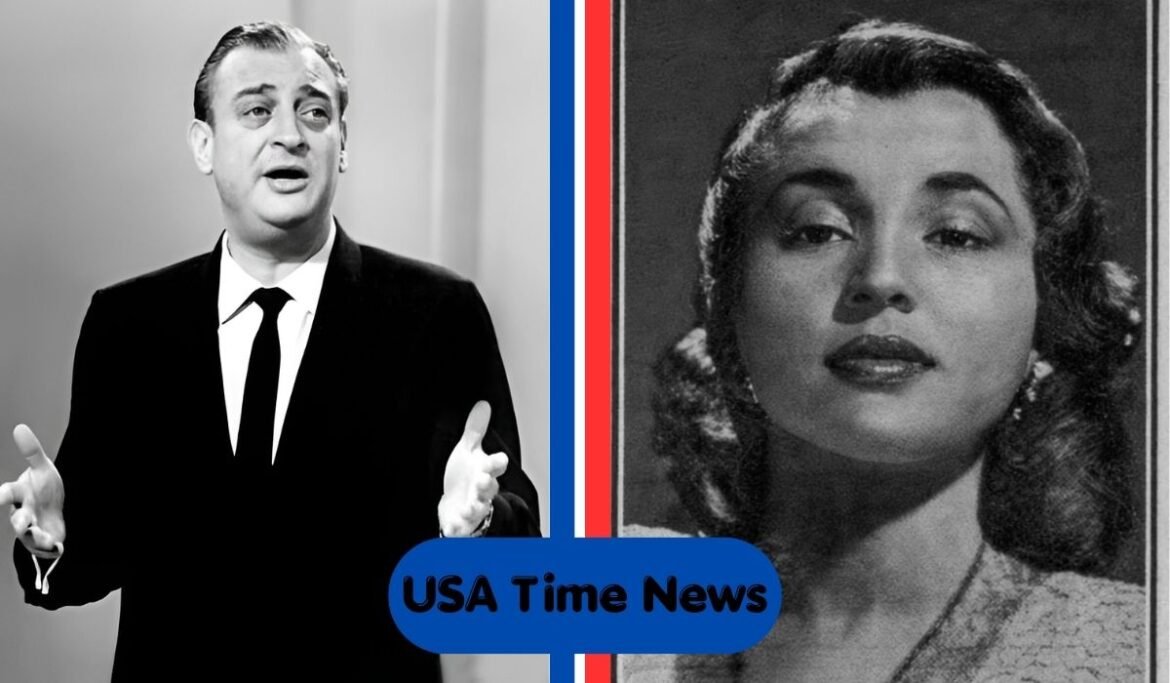
Joyce Indig married Rodney Dangerfield in 1951, more than 15 years before his March 1967 breakthrough on The Ed Sullivan Show.
Their relationship covered two marriages, two divorces, two children, and the difficult period when Dangerfield left comedy to sell paint and aluminum siding.
Indig was a singer when she met the future comedian at a New York club. At the time, audiences knew him by an earlier professional name, Jack Roy.
Her story is closely tied to Dangerfield’s years before Caddyshack, the Grammy-winning album No Respect, and his more than 70 appearances with Johnny Carson.
Joyce Indig’s Quick Facts
| Detail | Confirmed information |
|---|---|
| Full name | Joyce Indig |
| Married name | Joyce Roy |
| Profession | Singer |
| Former husband | Rodney Dangerfield |
| Husband’s birth name | Jacob Cohen |
| Name used when they met | Jack Roy |
| Meeting place | A New York club |
| First marriage | 1951 |
| First wedding date | October 3, 1951 |
| First divorce | Reported as 1961 or 1962 |
| Second marriage | 1963 |
| Final divorce | 1970 |
| Son | Brian Roy |
| Daughter | Melanie Roy |
| Family home | Englewood, New Jersey |
| Publicly known for | Her marriages to Rodney Dangerfield |
Who Was Joyce Indig?
Joyce Indig was a singer whose name became part of Rodney Dangerfield’s documented life story long before his success in television and movies.
She met Dangerfield at a New York club while he was performing as Jack Roy. He had adopted that professional identity after being born Jacob Cohen.
Both performers understood how uncertain nightclub work could be. Dangerfield’s bookings were inconsistent, despite having begun writing jokes when he was 15.
Their relationship developed before his “I don’t get no respect” persona existed. The nervous stage character, tight collar, white shirt, and red tie came later.
Indig therefore knew him during a rarely discussed phase, when he was an aspiring comedian rather than the established star seen in Back to School.
Her Career as a Singer
Major biographies and Dangerfield’s official history consistently identify Indig as a singer. Her documented work places her within New York’s live-entertainment culture.
The New York club where she met Jack Roy connected two performers facing the same problem: artistic ambition did not guarantee a dependable household income.
No established filmography or commercial discography is associated with Indig. Her public identity comes from live singing and her place in Dangerfield’s family history.
Her occupation matters because published accounts describe both partners as tired of the financial insecurity surrounding a performer’s life.
After marrying, the couple pursued a more conventional household in New Jersey. Dangerfield temporarily withdrew from professional comedy and entered sales work.
How She Met Rodney
Indig encountered Dangerfield when he was still using Jack Roy, a name he had legally adopted at 19 after beginning his career around the Catskills.
His early jobs paid little. One Catskills engagement reportedly brought him $12 a week plus room and meals, far from enough to support his intended family life.
Dangerfield also drove laundry and fish trucks while looking for comedy bookings. Those jobs belonged to the period surrounding his relationship with Indig.
By the time they married, he had spent years attempting to establish himself in clubs without achieving national recognition.
The couple’s meeting preceded his Rodney Dangerfield identity, his television breakthrough, and the opening of the Manhattan comedy club that carried his stage name.
Their First Wedding
Joyce Indig and Jack Roy married on October 3, 1951. That date appears in detailed accounts of Dangerfield’s personal history.
Some shorter biographies place the marriage in 1949, likely reflecting the year the couple met. The more specific chronology records their wedding in 1951.
Dangerfield was born on November 22, 1921, making him 29 at the time of the October ceremony.
The marriage prompted a major professional decision. He stepped away from the unstable comedy circuit and concentrated on providing a steadier income.
This was years before he asked an Inwood Lounge owner to bill him under a new name, leading to the professional identity Rodney Dangerfield.
Their New Jersey Home
After marrying, Joyce and Jack moved to Englewood, New Jersey. The relocation represented their attempt to exchange nightclub uncertainty for suburban stability.
Dangerfield later said the couple had wanted a house, children, and an ordinary family routine rather than the loneliness and travel surrounding show business.
During the 1950s, he sold paint and aluminum siding. Published accounts also describe him as continuing to write jokes while away from regular performances.
His sales career was practical, not a theatrical storyline created for his act. Supporting Indig and their growing family shaped that professional interruption.
The Englewood years came before national audiences encountered his self-deprecating character on The Ed Sullivan Show and The Tonight Show.
Meet Their Two Children
Indig and Dangerfield had two children, a son named Brian Roy and a daughter named Melanie Roy.
Brian was born in 1960, near the end of his parents’ first marriage. He was later identified publicly as a songwriter and singer.
Melanie was born after her parents reunited and married for a second time. She has appeared in family accounts under the name Melanie Roy-Friedman.
Their children connected Indig permanently to Dangerfield even after the final divorce. Contemporary obituaries listed Brian and Melanie among his survivors in 2004.
After Joyce’s death, Dangerfield assumed responsibility for raising both children. His parenting obligations influenced the way he organized his expanding comedy career.
Their First Divorce
The exact year of Joyce and Rodney’s first divorce varies between published sources. Detailed timelines use 1961, while major newspaper obituaries reported 1962.
What remains consistent is the sequence: the first marriage ended shortly after Brian’s birth, and the separation did not permanently end their relationship.
Dangerfield was nearing the start of his full professional comeback. At 42, he returned to performing with a renewed commitment to writing and delivering jokes.
He needed a distinct stage identity because Jack Roy had failed to secure strong bookings. Club owner George McFadden suggested Rodney Dangerfield.
That new name separated his comeback from the difficult career period he and Indig had experienced during their first marriage.
Why They Married Again
Joyce Indig and Rodney Dangerfield remarried in 1963, roughly one or two years after their first divorce.
Their second marriage lasted longer than the separation between the two unions. During that period, they welcomed their daughter, Melanie.
The remarriage coincided with Dangerfield’s effort to rebuild his comedy career in New York clubs and Catskills hotels.
He also developed the idea that his jokes needed a recognizable character. The result was a perpetually unlucky man who complained about receiving no respect.
Indig’s second period as his wife consequently overlapped with the construction of the stage persona that transformed his professional prospects.
Their Final Divorce
The couple divorced for the second and final time in 1970. By then, Dangerfield was becoming a familiar presence on national television.
Their combined history included nearly two decades between the 1951 wedding and the final legal separation, interrupted by the first divorce.
No reliable public account assigns one simple cause to the breakup. Contemporary profiles described a troubled domestic relationship without documenting private details from Indig’s perspective.
The final divorce occurred three years after Dangerfield’s breakthrough appearance on The Ed Sullivan Show on March 5, 1967.
He later married Joan Child in 1993. Indig remained his first wife and the mother of his only two children.
His Television Breakthrough
Dangerfield’s national breakthrough helps place Joyce Indig’s marriage in context. His first prominent Ed Sullivan Show appearance arrived 16 years after their wedding.
He appeared on Sullivan’s program repeatedly between 1967 and 1971. The exposure also led to engagements in Las Vegas and other major venues.
Between 1969 and 1992, he appeared more than 70 times on The Tonight Show Starring Johnny Carson, an unusually long association with the program.
The comedian also became a regular performer on The Dean Martin Show during the 1972–1973 television season.
Much of this success began during Indig’s second marriage to him, although his best-known film roles arrived a decade after their final divorce.
Joyce Indig’s Family Impact
After his former wife died, Dangerfield took a larger role in raising Brian and Melanie. Major obituaries directly connected that change with his career decisions.
Constant touring was poorly suited to his responsibilities as a father. He sought a way to perform regularly while remaining close to his children in New York.
In 1969, Dangerfield and business partner Anthony Bevacqua established Dangerfield’s comedy club in Manhattan. The venue became central to his later professional life.
The club eventually presented performers including Jerry Seinfeld, Jim Carrey, Roseanne Barr, Sam Kinison, Rita Rudner, and Bob Saget in HBO productions.
Indig never shared in the celebrity phase as a public figure, yet her children and her death affected how Dangerfield balanced parenthood, touring, and club ownership.
Her Son Brian’s Music
Brian Roy followed his parents into music, becoming known as a singer and songwriter rather than pursuing his father’s stand-up profession.
Published accounts identify Brian as Joyce’s first child and place his birth in 1960. He was still a teenager when his mother died.
His recording history includes “She Was My Harbor,” a ballad associated with the 1992 Dennis Hopper crime drama Nails.
The film starred Hopper and Anne Archer and was distributed for television through Viacom and Showtime. Brian’s song honored family associate Estelle Adler.
His work provides a direct artistic link to both parents: Indig performed as a singer, while Dangerfield wrote and recorded comedy and novelty music.
Rodney’s Career After Joyce
Dangerfield played wealthy developer Al Czervik opposite Chevy Chase, Bill Murray, and Ted Knight in the 1980 golf comedy Caddyshack.
That same year, his comedy recording No Respect established one of his biggest commercial achievements and later won the Grammy for Best Comedy Recording.
He co-wrote and starred as Monty Capuletti in Easy Money in 1983, then played college student Thornton Melon in Back to School in 1986.
A rare dramatic performance followed in Oliver Stone’s Natural Born Killers in 1994, where Dangerfield portrayed Mallory Knox’s abusive father, Ed Wilson.
These projects belong to the period after his life with Indig, but they explain why public curiosity later expanded to include his first wife and early family.
Was Joyce Indig Famous?
Joyce Indig was a working singer, not a nationally marketed celebrity with a documented screen career or major recording catalog.
Her recognition developed primarily through Dangerfield biographies, newspaper obituaries, and accounts of his departure from comedy during the 1950s.
She did not appear in his signature films, including Caddyshack, Easy Money, Back to School, or Ladybugs.
Nor was she his spouse when he received a Hollywood Walk of Fame star in 2002. Their final divorce had occurred 32 years earlier.
Calling her simply a “celebrity wife” misses the chronology. Indig knew and married Jack Roy before the Rodney Dangerfield character brought him national attention.
Her Place in His Story
Joyce Indig’s documented life shows how much of Rodney Dangerfield’s career unfolded around family obligations rather than uninterrupted show-business momentum.
Their 1951 marriage came before his retreat into sales, and their first separation preceded his return to comedy under a new professional name.
The 1963 remarriage overlapped with his efforts to perfect the anxious, disrespected character that audiences soon recognized on television.
Following Indig’s death, responsibility for Brian and Melanie contributed to Dangerfield’s decision to limit travel and work from his Manhattan club.
Joyce Indig deserves careful treatment as a singer, twice-married partner, and mother whose family history intersected with several turning points in American comedy.
Frequently Asked Questions
1. Who was Joyce Indig?
Joyce Indig was a singer and the first wife of comedian Rodney Dangerfield. She met him at a New York club when he was performing under the name Jack Roy.
2. When did Joyce marry Rodney?
Indig and Dangerfield first married on October 3, 1951. They remarried in 1963 following a divorce reported as occurring in either 1961 or 1962.
3. How many times did they marry?
Joyce and Rodney married each other twice. Their second and final divorce occurred in 1970, three years after his national breakthrough on The Ed Sullivan Show.
4. Did Joyce Indig have children?
She had two children with Dangerfield, Brian Roy and Melanie Roy. Brian was born in 1960, while Melanie arrived after the couple’s 1963 remarriage.
5. What did Joyce do professionally?
Published biographies identify Joyce as a singer. She met Dangerfield while connected to New York’s club-entertainment scene, before he adopted his famous stage identity.
6. Where did their family live?
The family settled in Englewood, New Jersey. During those years, Dangerfield left regular comedy work and sold paint and aluminum siding to support the household.
7. Was Joyce in Rodney’s movies?
Joyce did not have a documented role in Dangerfield’s movies. His best-known films, including Caddyshack and Back to School, were released after their 1970 divorce.
8. Who were Joyce’s children?
Her son was Brian Roy, who later worked in music, and her daughter was Melanie Roy. Both were listed among Dangerfield’s surviving children after his death in 2004.
Read Next: Who Is Paul Krasinski? Everything About John Krasinski’s Brother